
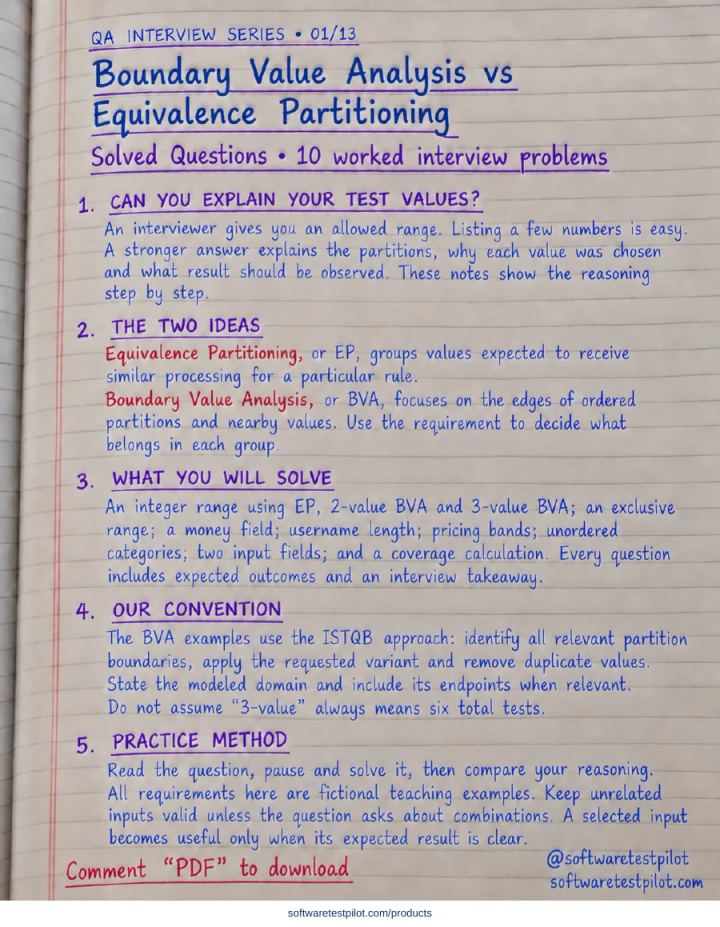
Boundary Value Analysis vs Equivalence Partitioning: Solved Questions
Published by SoftwareTestPilot
PDF • 13 pages • Practice Questions • Beginner • Manual Testing
Published 3 November 2026 • Updated 3 November 2026
Included in QA Notes Vault
Preview this resource below, or unlock the complete QA Notes Vault for ₹199 lifetime access.
A 13-page practice questions covering ep vs bva: understand the difference, q01 - solve the range with ep, q02 - solve the same range with 2-value bva, q03 - why 3-value bva gives eight here.
Already bought the Vault?
Read Boundary Value Analysis vs Equivalence Partitioning: Solved Questions
Opening the note…
Like this resource? Unlock this plus 175+ other QA notes with lifetime Vault access.
Overview
This guide covers Equivalence Partitioning (EP) and Boundary Value Analysis (BVA) through worked interview problems. It details techniques for modeling input domains, identifying valid and invalid partitions, and determining boundary values for integer ranges, exclusive limits, decimal currency fields, string lengths, and multi-tier pricing bands. The material applies the ISTQB convention to establish 2-value and 3-value boundary test sets while removing duplicate inputs. The notes help software testers and interview candidates explain test data choices, boundary transitions, and expected outcomes systematically. Readers examine specific defects targeted by edge checks and practice justifying partition models and coverage objectives during technical QA interviews.
What you'll learn
- Differentiate equivalence partitioning groups from ordered boundary value transitions.
- Construct 2-value and 3-value boundary test sets for integer ranges.
- Translate exclusive boundary requirements into accepted and rejected test values.
- Select boundary values for decimal currency based on agreed precision steps.
- Identify finite domain endpoints such as string length zero.
- Partition multi-tier pricing bands according to distinct calculation rules.
Topics covered
- boundary value analysis
- equivalence partitioning
- test design techniques
- bva
- interview questions
Table of contents
- EP vs BVA: understand the difference
- Q01 - Solve the range with EP
- Q02 - Solve the same range with 2-value BVA
- Q03 - Why 3-value BVA gives eight here
- Q04 - Exclusive limits change the answer
- Q05 - Money: the step is one paisa
- Q06 - Username length has a domain edge
- Q07 - Pricing bands create more partitions
Selected preview
EP vs BVA: understand the difference
Extract from the PDF pages of this resource.
Skills covered
- Test Design
- Boundary Value Analysis
- Equivalence Partitioning
Who this resource is for
- QA Engineers
- Software Testers
Format and what you get
- A downloadable PDF you can read on phone or laptop.
- Included in the QA Notes Vault: one payment unlocks every note in the Vault, with lifetime access to it.
- Download after signing in with the account that paid. Refunds follow our refund policy.
Free learning on this topic
Boundary Value Analysis vs Equivalence Partitioning: Solved Questions: common questions
1.What does Boundary Value Analysis vs Equivalence Partitioning: Solved Questions cover?
2.How long is this PDF and what format is it in?
3.Who is this resource for?
4.How do I get the full PDF?
QA Notes Vault
Get Boundary Value Analysis vs Equivalence Partitioning: Solved Questions and the complete Vault
Download this resource in full, plus 175+ other quick-revision QA notes — all for ₹199 with lifetime access.
- One-time payment
- Lifetime access
- Secure checkout
Related QA Resources
More notes on this topic, all included in the same Vault purchase.
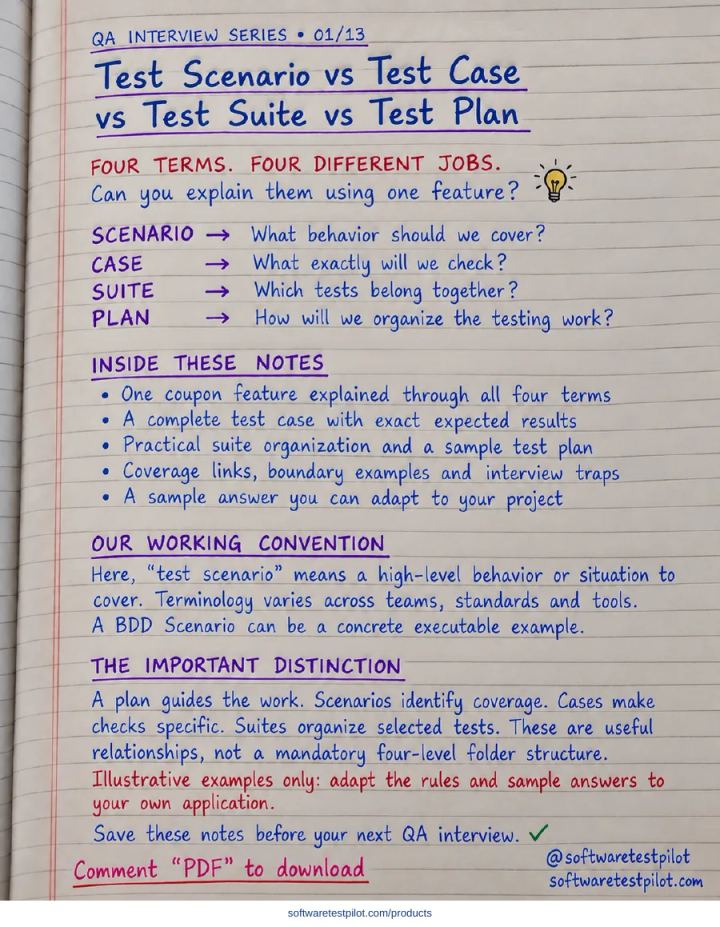
Test Scenario vs Test Case vs Test Suite vs Test Plan
Included in QA Notes VaultComparison Guide· Beginner· 13 pages
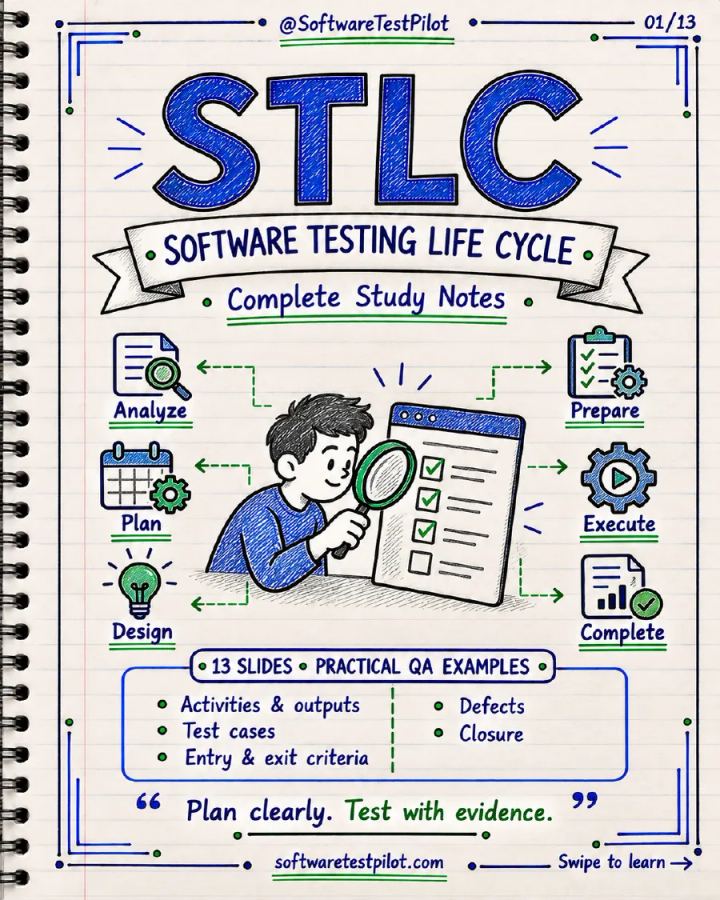
STLC: Complete Notes
Included in QA Notes VaultStudy Notes· Beginner· 13 pages
200 Manual Testing Interview Questions & Detailed Answers
Included in QA Notes VaultInterview Questions· Beginner to Advanced· 35 pages
Agile Methodology Complete Notes
Included in QA Notes VaultStudy Notes· Beginner· 13 pages
Retrospective Meeting Complete Notes
Included in QA Notes VaultStudy Notes· All Levels· 13 pages
Bug Triage Meeting Complete Notes
Included in QA Notes VaultStudy Notes· Intermediate· 13 pages