
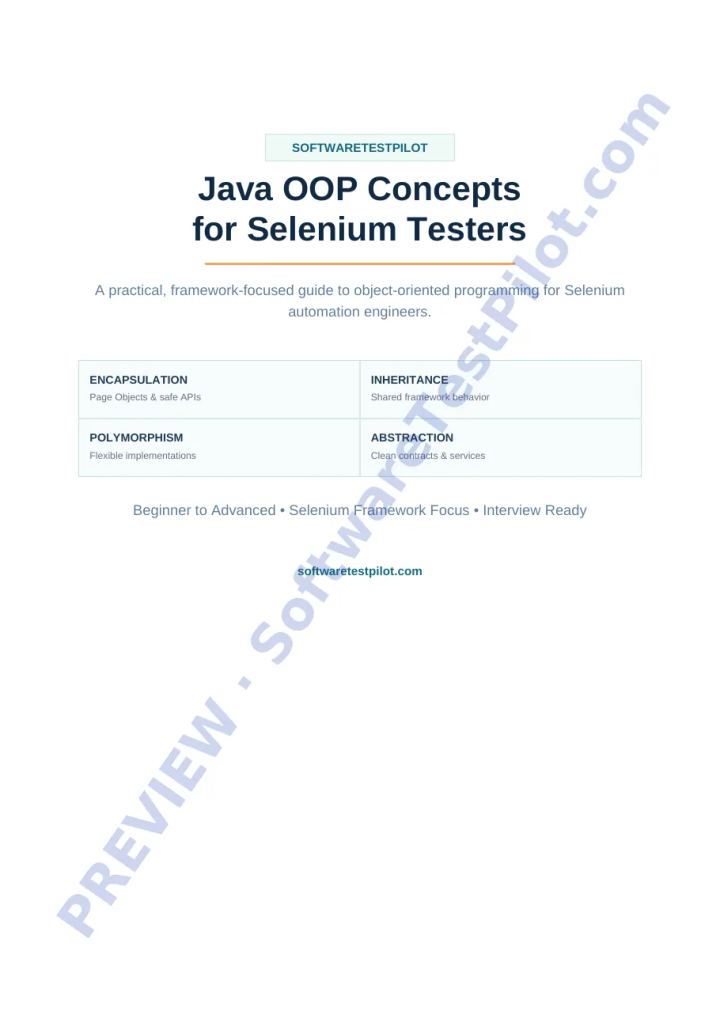
Java OOP Concepts for Selenium Testers
Published by SoftwareTestPilot
PDF • 13 pages • Notes • Beginner to Advanced • Java for QA
Published 5 October 2026 • Updated 5 October 2026
Included in QA Notes Vault
Preview this resource below, or unlock the complete QA Notes Vault for ₹199 lifetime access.
This guide provides a practical, framework-focused approach to Object-Oriented Programming (OOP) concepts for Selenium automation engineers.
Already bought the Vault?
Read Java OOP Concepts for Selenium Testers
Opening the note…
Like this resource? Unlock this plus 175+ other QA notes with lifetime Vault access.
Overview
This guide provides a practical, framework-focused approach to Object-Oriented Programming (OOP) concepts for Selenium automation engineers. It details how OOP principles like encapsulation, inheritance, polymorphism, and abstraction apply directly to building maintainable and scalable Selenium test automation frameworks. The guide moves from fundamental OOP concepts to advanced topics and design principles, offering examples and insights relevant to a Selenium testing context. The PDF is designed for Selenium testers who want to understand and apply OOP to improve their test automation. It helps in structuring UI actions, locators, driver setup, and test data into reusable building blocks. Testers will learn to separate responsibilities into classes, objects, interfaces, and reusable components, making frameworks easier to scale and maintain.
What you'll learn
- Apply OOP to Selenium frameworks
- Structure reusable test automation components
- Utilize encapsulation for safe APIs
- Implement inheritance for shared behavior
- Employ polymorphism for flexible code
- Define clear contracts with abstraction
- Understand SOLID principles for design
Topics covered
- selenium
Table of contents
- Why OOP Matters in Selenium
- Class, Object & Method
- Constructors in Page Objects
- Encapsulation
- Getters, Setters & Controlled State
- Inheritance
- super and this
- Method Overloading
- Method Overriding
- Polymorphism
- Compile-time vs Runtime Polymorphism
- Abstraction
- Abstract Class vs Interface
- Access Modifiers
- Composition
- Association, Aggregation & Composition
- Static Members
- final Keyword
- Object Class Methods
- SOLID for Selenium Frameworks
- Page Object Model Through OOP
- BasePage Design - Good vs Bad
Selected preview
SOFTWARETESTPILOT https://softwaretestpilot.com/products 02 01 Why OOP Matters in Selenium OOP is not theory - it is the structure behind maintainable test automation frameworks. A Selenium script can work without strong OOP, but a Selenium framework becomes easier to scale when responsibilities are separated into classes, objects, interfaces, and reusable components. QA NOTE Think like a tester OOP helps you turn repeated UI actions, locators, driver setup, waits, API helpers, and test data into reusable building blocks instead of copying code across tests. Page Object Model uses encapsulation to keep locators and page actions together. Base test classes often use inheritance to share setup and teardown. Interfaces and abstract classes help define reusable contracts. Polymorphism makes it easier to swap browser, environment, logger, driver, or service implementations. LoginPage
Extract from the PDF pages of this resource.
Tools covered
- Selenium
Skills covered
- Java for QA
- Selenium
Who this resource is for
- Fresher
- Automation Tester
Format and what you get
- A downloadable PDF you can read on phone or laptop.
- Included in the QA Notes Vault: one payment unlocks every note in the Vault, with lifetime access to it.
- Download after signing in with the account that paid. Refunds follow our refund policy.
Free learning on this topic
Java OOP Concepts for Selenium Testers: common questions
1.What does Java OOP Concepts for Selenium Testers cover?
2.How long is this PDF and what format is it in?
3.Who is this resource for?
4.How do I get the full PDF?
QA Notes Vault
Get Java OOP Concepts for Selenium Testers and the complete Vault
Download this resource in full, plus 175+ other quick-revision QA notes — all for ₹199 with lifetime access.
- One-time payment
- Lifetime access
- Secure checkout
Related QA Resources
More notes on this topic, all included in the same Vault purchase.
Java Complete Notes for Automation Testers
Included in QA Notes VaultNotes· Beginner· 39 pages
Java Collections Complete Guide for Testers
Included in QA Notes VaultReference Guide· Advanced· 28 pages
100 Java Coding Programs for QA and SDET Interviews — Complete Edition
Included in QA Notes VaultInterview Questions· Beginner to Advanced· 56 pages
Java String Coding Problems for QA Interviews
Included in QA Notes VaultCoding Problems· Advanced· 23 pages